Organic Cinnamon Leaf Essential Oil (Cinnamomum verum) — 15 ml
- Regular Price
- $ 17.99
- Sale Price
- $ 17.99
- Regular Price
Sold Out
- Unit Price
- per
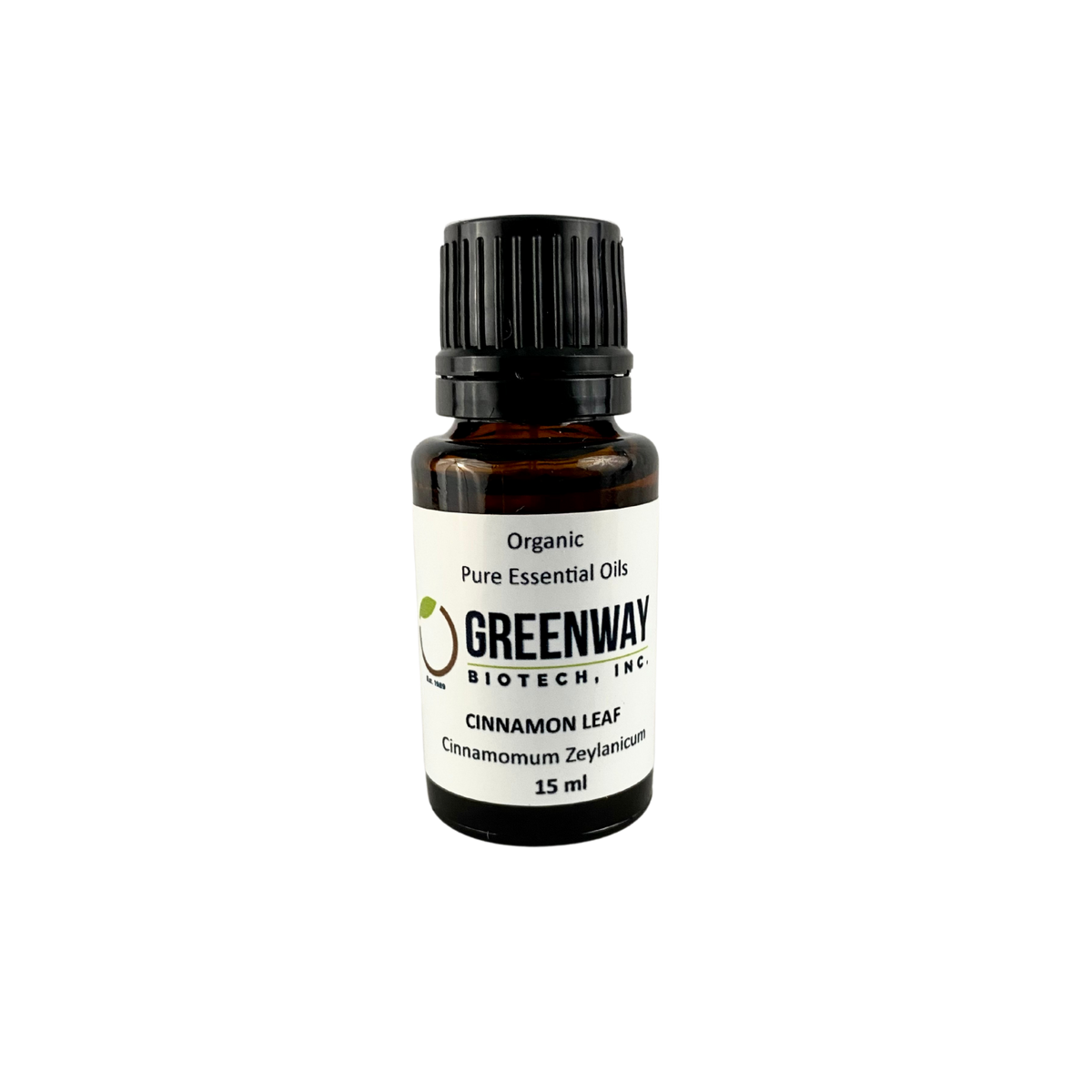
100% pure organic Cinnamomum verum leaf oil, steam-distilled from certified-organic Sri Lankan cinnamon leaves. Eugenol-rich, with a warm, clove-like aroma — best in diffusers, holiday blends, and natural cleaning sprays. 15 ml dark amber glass bottle, hand-bottled in the USA.
Find your size → See how to use itShips from California · 90-day guarantee · GC/MS available on request
100%
Pure organic Cinnamomum verum
15ml
≈ 300 drops per bottle
68-87%
Eugenol content (the warm note)
GC/MS
Batch verified
Cinnamon leaf is used sparingly — 1 to 3 drops at a time — so a single 15 ml bottle stretches a long way for most home routines. Stored properly in the included amber glass, the oil keeps its character for 3 to 5 years.
| Size | Typical Duration | Uses per Bottle | Best For |
|---|---|---|---|
| 15 ml dark amber glass | 1-3 years (typical home use) | ~300 drops | Best starter size |
| Product Type | Single-origin essential oil |
|---|---|
| Size | 15 ml (≈ 300 drops) dark amber glass with euro dropper cap |
| Key Ingredient | Cinnamon Leaf Oil (Cinnamomum verum, syn. C. zeylanicum) — true Ceylon cinnamon |
| Source / Origin | Certified-organic plantations in Sri Lanka (the ancestral home of true cinnamon) |
| Grade / Purity | 100% pure, certified organic, GC/MS verified — no fillers, no carrier oils, no synthetic fragrance |
| Aroma | Warm, spicy, musky — closer to clove than bark cinnamon, with sweet herbaceous depth |
| Aromatic Note | Middle note — gives body and warmth to blends |
| Extraction | Steam distilled from the leaves (not the bark) |
| Phototoxic | No — no UV avoidance window required after topical use |
| Max Topical Dilution | 0.6% (~1-2 drops per tablespoon of carrier oil) — one of the lowest among common EOs |
| Safety | External use only; patch test before first use. See Safety section below for full guidance and drug-interaction notes. |
Cinnamon leaf earns its place in the cabinet through diffusing, blending, and cleaning more than through skin application — its very low topical limit makes it primarily an aromatherapy oil.
One to three drops in a diffuser. The warm, spicy aroma fills a room quickly — start with one drop and add more if you want.
A staple in fall and winter blends — one or two drops alongside sweet orange and patchouli for cozy, holiday-leaning atmospheres.
10-15 drops in a 16 oz spray bottle of water with a teaspoon of castile soap. Warm spice + fresh space — wear gloves when spraying.
A little goes a very long way. One or two drops adds warm spicy depth to citrus, floral, and woodsy blends without overwhelming them.
Popular in handmade candles, wax melts, and cold-process soap for its warm, inviting character. Follow your wax or soap formulation guidelines for eugenol-containing oils.
Used in surface and clothing sprays as a botanical accent. Do not apply directly to skin without proper dilution — see the safety section.
Cinnamon leaf and cinnamon bark are two different oils with two different aromas, two different chemistries, and two different recommended uses. This is the leaf — gentler, warmer, more versatile.
Sri Lanka (formerly Ceylon) is the ancestral home of true cinnamon — Cinnamomum verum, distinct from and considered finer than the cassia (C. cassia) species grown elsewhere. Our leaves are sourced from certified-organic plantations, with no synthetic pesticides or fertilizers in the production chain.
Gentle steam distillation from the leaves yields an oil rich in eugenol — the phenolic compound also found in clove that gives this oil its warm, clove-like character. Steam keeps the constituent profile intact without solvents or heat-degradation byproducts.
What's in the bottle is steam-distilled Cinnamomum verum leaf oil and nothing else. No synthetic additives, no carrier oils diluting the active material, no fragrance oils mimicking the aroma. The label lists one ingredient.
Each batch is GC/MS analyzed by an independent lab to verify the constituent profile and screen for adulterants. Lot-coded for traceability so any bottle can be tracked back to its source plantation and batch.
Amber glass shields the oil from UV light, the leading cause of essential-oil oxidation. The euro dropper cap gives consistent drop control — important for an oil this concentrated — and reduces air exposure between uses.
Distilled in Sri Lanka, hand-filled and inspected at our family-owned Madera, California facility — the same facility that has produced Greenway products since 1989. Backed by a 90-day money-back guarantee on every bottle.
68-87% eugenol
The phenolic compound responsible for the warm, clove-like character
Cinnamon leaf oil and cinnamon bark oil come from the same tree but are not interchangeable. The leaves yield an oil that is predominantly eugenol (68-87%) — the same compound that dominates clove oil. The bark, by contrast, yields an oil that is predominantly cinnamaldehyde (45-65%) — the sharp, sweet, fiery compound most people associate with the word "cinnamon."
This chemistry difference produces a real aroma difference. Leaf oil reads as warm, spicy, and clove-adjacent with a sweet herbaceous depth — closer to a baking spice cabinet than to a Red Hots candy. Bark oil reads as fiery and immediately recognizable as cinnamon. The leaf is generally considered the gentler of the two and more versatile for everyday aromatherapy blending, though both require careful dilution because high-phenol oils can irritate skin and mucous membranes at higher concentrations.
The practical implication for this bottle: cinnamon leaf is primarily a diffusing and blending oil, not a skincare oil. Its very low topical limit (0.6%) reflects eugenol's irritation potential, not a defect of the oil — it is doing exactly what an eugenol-rich oil should do.
Constituent ranges below reflect typical batch profiles for steam-distilled Cinnamomum verum leaf oil. The current-batch GC/MS report is available on request.
The dominant phenolic compound — the source of the warm, clove-like, spicy-sweet character. Also responsible for the 0.6% topical dilution limit; high eugenol concentrations can irritate skin and mucous membranes.
A woody, slightly peppery sesquiterpene found in clove, hops, and black pepper. Adds depth and length to the aromatic profile.
A naturally occurring terpene alcohol that contributes a soft, slightly floral undertone — the same compound found in lavender.
Present in small amounts in the leaf oil — the dominant compound in bark oil but a minor component here. Contributes a hint of recognizable cinnamon character on top of the eugenol base.
A naturally occurring ester present in small amounts. Contributes to the oil's slight musky depth.
Allergen / sensitizer note: high eugenol content can sensitize skin and irritate mucous membranes — always dilute below 0.6% before any topical use, and patch test first. People taking anticoagulant or antiplatelet medications should consult a healthcare provider before use; eugenol may inhibit blood clotting. Discontinue use at least two weeks before any scheduled surgery.
| Botanical Name | Cinnamomum verum J. Presl (syn. C. zeylanicum Blume) |
|---|---|
| Common Names | True cinnamon, Ceylon cinnamon, Sri Lankan cinnamon |
| Plant Part Used | Leaves |
| Extraction Method | Steam distillation |
| Country of Origin | Sri Lanka (certified organic plantations) |
| Grade | 100% pure, certified organic, GC/MS verified |
| Color & Appearance | Yellow to brown, mobile liquid |
| Aroma Profile | Warm, spicy, musky, clove-adjacent with sweet herbaceous depth |
| Aromatic Note | Middle note |
| Primary Constituent | Eugenol (68-87%) |
| Net Volume | 15 ml (≈ 300 drops) |
| Container | Dark amber glass bottle with euro dropper cap and tamper-evident seal |
| Phototoxicity | Non-phototoxic — no UV avoidance window required |
| Maximum Topical Dilution | 0.6% (Tisserand & Young, 2014) |
| Shelf Life | 3-5 years when stored sealed in a cool, dark place |
| Packaged At | Greenway Biotech facility, Madera, California |
| Testing | Third-party GC/MS verification per batch; lot-coded for traceability |
Three primary use methods. Every drop count below is consistent with the 0.6% maximum topical dilution from Tisserand & Young (2014). When in doubt, use less.
Quick answer: 1-2 drops MAX per tablespoon (15 ml) of carrier oil. Skin application is the least-recommended use for this oil.
| Carrier Oil Volume | Cinnamon Leaf Drops | Approx. Dilution | Notes |
|---|---|---|---|
| 1 tsp (5 ml) | 1 drop max | ~0.6% | Spot use only; avoid face, broken skin, sensitive areas |
| 1 tbsp (15 ml) | 1-2 drops max | ~0.3-0.6% | Body massage blends; pair with gentler oils |
| 2 tbsp (30 ml) | 2-3 drops max | ~0.3-0.5% | Larger massage blends |
Suitable carrier oils: jojoba, sweet almond, fractionated coconut, grapeseed, avocado. Available at most health-food stores. Patch test any blend on the inner forearm and wait 24 hours before broader use.
Quick answer: Start with 1 drop in your diffuser water. Cinnamon leaf is strong — a little goes a long way.
| Room Size | Cinnamon Leaf Drops | Duration | Notes |
|---|---|---|---|
| Small (bathroom, closet) | 1 drop | 15-20 minutes | Even one drop is noticeable in tight spaces |
| Medium (bedroom, office) | 1-2 drops | 20-30 minutes | Add a top note like sweet orange for balance |
| Large (living room, kitchen) | 2-3 drops | 30-40 minutes | Take breaks between sessions for sensory reset |
Holiday blend starter: 1 drop cinnamon leaf + 3 drops Sweet Orange + 1 drop Patchouli. Diffuse 20-30 minutes. Adjust ratios to taste on subsequent runs.
Quick answer: 10-15 drops per 16 oz (480 ml) of water with an emulsifier. Surface use only — not for skin.
Three habits separate a comfortable cinnamon leaf experience from an irritating one. Build them into your routine on day one.
Mix 1 drop of cinnamon leaf in 1 tablespoon (15 ml) of carrier oil. Apply a small amount to the inner forearm and wait 24 hours. If no redness, itching, or burning appears, the dilution is workable for you. If anything appears, skip topical use entirely — diffuse instead.
Whether in a diffuser, a blend, or a cleaning spray, start with one drop and adjust upward only after you've seen how the room (or your skin) responds. Eugenol is potent — restraint is the right default.
Eugenol may inhibit blood clotting. If you take anticoagulant (warfarin, heparin) or antiplatelet (aspirin, clopidogrel) medications, consult your healthcare provider before any use — even diffusing — and discontinue use at least two weeks before any scheduled surgery.
Twenty to thirty minutes per session with breaks between sessions is plenty for most rooms. Continuous all-day diffusing of a phenolic oil can fatigue the senses and crowd out the rest of a blend.
Cinnamon leaf is a middle note — it adds body and warmth to blends but isn't the star. Pair with top notes (citrus, eucalyptus) for sparkle and base notes (patchouli, vetiver) for grounding. The result is more interesting than cinnamon alone.
Cats are particularly sensitive to phenol-rich essential oils, including eugenol. Do not apply cinnamon leaf to pets. When diffusing in homes with cats or dogs, use minimal amounts, keep the room well-ventilated, and ensure animals have a clear exit route.
For aromatherapy use. Dilute before topical application. Keep out of reach of children. Essential oils are not intended to diagnose, treat, cure, or prevent disease.
Cinnamon leaf and cinnamon bark come from the same tree but behave like different oils. This is how they line up against each other and against other warm-spicy diffusing options.
| Oil | Primary Compound | Aroma Character | Max Topical | Best For |
|---|---|---|---|---|
| Cinnamon Leaf (this product) | Eugenol 68-87% | Warm, clove-like, sweet-herbaceous | 0.6% | Diffusing, holiday blends, cleaning sprays |
| Cinnamon Bark | Cinnamaldehyde 45-65% | Sharp, sweet, fiery — "classic cinnamon" | 0.07% | Very sparing diffusing only; demanding to handle |
| Patchouli | Patchoulol & sesquiterpenes | Earthy, woody, grounding base note | 3%+ (generally well tolerated) | Grounding evening blends; pairs with cinnamon leaf |
| Sweet Orange | Limonene >90% | Bright, sweet, cheerful citrus top note | Generally non-irritant | Cinnamon's #1 pairing for fall & holiday blends |
Honest sorting — cinnamon leaf does some things very well and isn't the right pick for every routine.
A middle note like cinnamon leaf wants a top note for brightness and a base note for grounding. These four are its most popular partners.
The #1 cinnamon pairing — bright, sweet citrus plus warm spice is the classic fall and holiday blend. 3 drops orange + 1 drop cinnamon leaf is the starting ratio.
Essential OilThe grounding base note that anchors cinnamon's warmth. Together they create a rich, exotic, deeply grounding blend ideal for evening diffusing.
Essential OilCalming floral plus warm spice is an unexpected but sophisticated combination — soft and cozy without being heavy. Pairs well with geranium for added floral depth.
Essential OilCool eucalyptus plus warm cinnamon makes a dynamic, invigorating diffuser blend with freshness and depth — popular for winter and holiday rooms.
Cinnamon leaf is a powerful eugenol-rich oil. Used carefully it's a pleasure to work with; used carelessly it can irritate skin, irritate mucous membranes, and interact with medications.
If your question isn't here, contact our team at questions@greenwaybiotech.com.
Yes. Our cinnamon leaf essential oil is 100% pure, certified organic Cinnamomum verum from Sri Lanka. It contains no synthetic additives, fillers, fragrance oils, or carrier oils. It is steam-distilled from cinnamon leaves and hand-bottled at our family-owned Madera, California facility.
Warm, spicy, and musky — closer to clove than to cinnamon bark, with a sweet, herbaceous depth. This is because cinnamon leaf is primarily eugenol (68-87%), the same compound that dominates clove oil. The sharp, fiery "cinnamon" scent most people recognize from candy comes from cinnamaldehyde, which is the dominant compound in cinnamon bark oil — not leaf oil.
Same tree, different oils. Leaf oil is distilled from the leaves and is primarily eugenol (68-87%) — warm, clove-like, gentler. Bark oil is distilled from the bark and is primarily cinnamaldehyde (45-65%) — sharp, sweet, fiery. Both require careful dilution, but leaf oil has a much higher topical limit (0.6%) than bark oil (0.07%) and is generally considered more versatile for everyday aromatherapy blending. For most home users, leaf oil is the right call.
The high eugenol content (68-87%) can irritate skin and mucous membranes at concentrations above 0.6%. This is one of the lowest topical limits among common essential oils. The limit isn't a defect of the oil — it's what an eugenol-rich oil should look like. The practical conclusion is that cinnamon leaf is primarily a diffusing and blending oil, not a skincare oil. If applying to skin, never exceed 1-2 drops per tablespoon of carrier oil.
Yes. Eugenol may inhibit blood clotting. If you take anticoagulant medications (such as warfarin or heparin) or antiplatelet medications (such as aspirin or clopidogrel), consult your healthcare provider before using cinnamon leaf oil, even in a diffuser. Discontinue use at least two weeks before any scheduled surgery. This interaction is the most important safety consideration for this oil — please don't skip it.
No. Cinnamon leaf is non-phototoxic, meaning you don't need to avoid sunlight after topical application. The 0.6% topical dilution limit still applies regardless of UV exposure, but there is no UV avoidance window required.
We don't recommend it. The high eugenol content can irritate skin, and water doesn't adequately dilute essential oils — they float on the surface and concentrate against skin on contact. For warm spice in a bath setting, diffuse cinnamon leaf nearby instead and use a gentler oil like Lavender or Sweet Orange in the bath itself, properly mixed into Epsom salt or magnesium flakes first.
Due to the very low topical limit and potential for skin irritation, topical use of cinnamon leaf on children is not recommended. If diffusing around children, use minimal amounts (1 drop) in a well-ventilated space and observe for any sensitivity. Always consult a pediatrician before using essential oils around children.
Cats are particularly sensitive to phenolic essential oils, including eugenol-rich oils like cinnamon leaf. Do not apply to pets. When diffusing, keep the area well-ventilated and ensure animals have a clear exit route. Consult your veterinarian before using any essential oil around pets, especially cats.
Approximately 300 drops using the standard euro dropper cap included with each bottle. Since cinnamon leaf is used in very small amounts (1-3 drops at a time), a single 15 ml bottle lasts a very long time — most home users get well over a year of regular use from one bottle.
Store in a cool, dark place with the cap tightly sealed. The dark amber glass bottle protects against UV light, which is the leading cause of essential-oil oxidation. Expected shelf life is 3-5 years when stored properly. Refrigeration isn't required but won't harm the oil. A useful habit: write the date you opened the bottle on the label so you can track freshness over time.
No. Our essential oils are formulated, tested, and labeled for external use only. Essential oils are extremely concentrated — cinnamon leaf oil is not the same as culinary cinnamon. For cooking, use whole cinnamon sticks or ground cinnamon instead. Essential oils are not intended to diagnose, treat, cure, or prevent disease.
Sri Lanka (formerly Ceylon) is the ancestral home of true cinnamon — Cinnamomum verum. Sri Lankan cinnamon is considered the gold standard for the species, distinct from and considered finer than cassia cinnamon (C. cassia) from China or Indonesia. The leaf oil from true cinnamon has a more refined, complex aroma profile with its characteristic warm, clove-like eugenol character.
One 15 ml dark amber glass bottle. Distilled in Sri Lanka, hand-filled in Madera, California. Free shipping on orders over $100 in the continental US, and a 90-day money-back guarantee if cinnamon leaf isn't right for your routine.
Choose your size →Ships from California · 90-day guarantee · GC/MS reports above